
What is PLA fiber? Polylactic Acid (PLA) fiber, often referred to as “corn fiber,” is a 100% bio-based and biodegradable synthetic fiber derived from renewable plant resources such as corn and cassava. Processed from plant to fabric, PLA fiber provides a revolutionary, eco-friendly alternative to traditional petroleum-based plastics like polyester (PET).
As global industries shift towards low-carbon and sustainable development, PLA fiber is leading a massive transition across disposable hygiene products, home textiles, apparel, and packaging. In this comprehensive guide, we will explore its unique properties, technical processing specifications, blending advantages, and why it is the future of the textile and nonwoven industries.
- 1. 5 Key Advantages of PLA Fiber: Why Transition to PLA?
- 2. Technical Specifications & Processing Guide (PLA vs. PET vs. Cotton)
- 3. The "1+1 > 2" Magic: Blending PLA with Natural Fibers
- 4. Innovation Spotlight: PLA Bi-component Staples
- 5. Major Applications of PLA Fiber
- 6. Partner with eSUN: Your Trusted PLA Fiber Supplier
1. 5 Key Advantages of PLA Fiber: Why Transition to PLA?
Based on comprehensive industry testing, PLA fiber offers five core advantages that combine comfort, safety, and environmental responsibility:
100% Biodegradable & Low Carbon Footprint
Derived from nature, PLA returns to nature. Under composting environments, it decomposes completely into carbon dioxide and water, causing no “white pollution.” The Global Warming Potential (GWP) of PLA is approximately 0.5 kg CO2 eq/kg, representing a carbon footprint reduction of about 75% compared to typical fossil-based polymers (like PET or PP).
Natural Antibacterial & Anti-Mite Properties
The core component of PLA is lactic acid. This gives the fiber surface a weakly acidic environment that perfectly matches the pH of human skin, naturally inhibiting bacteria and mites. eSUN’s tests demonstrate an antibacterial rate of over 99.9% against Staphylococcus aureus, Escherichia coli, and Candida albicans.
Hypoallergenic & Skin-Friendly
Because lactic acid is an endogenous substance naturally found in the human body, PLA fiber boasts exceptional biocompatibility. It rarely causes allergic reactions, acting as a “natural protective shield” ideal for sensitive skin, infant care, and feminine hygiene products.
Exceptional Breathability and Moisture Conductivity
PLA fiber features numerous micropores that allow air to flow freely. Its outstanding hydrophobic properties quickly guide liquid away from the skin. Even when damp, PLA fiber rapidly returns to a dry state, eliminating the “stuffiness” often associated with traditional sanitary products and innerwear.
High Bulkiness & Resilience (3D Crimped) & Flame Retardant
When engineered into a 3D crimped structure, PLA fiber exhibits exceptional bulkiness (high loft) and remarkable resilience. This provides a superior, safer, and eco-friendly filling alternative for home textiles (quilts, pillows) and plush toys. Furthermore, it is naturally flame retardant—self-extinguishing when removed from a fire source and emitting no toxic black smoke.
2. Technical Specifications & Processing Guide (PLA vs. PET vs. Cotton)
For engineers and textile manufacturers, understanding the physical properties of PLA is crucial for adjusting production lines. Here is how eSUN’s standard PLA staple fiber compares mechanically to traditional Polyester (PET) and Cotton:
| Feature | PLA Fiber | Polyester | Cotton |
|---|---|---|---|
| Origin | Bio-based (Plants) | Petroleum-based | Natural Plant |
| Tenacity (Strength) | 2.5 ~ 4.5 cN/dtex | ~ 4.5 – 6.0 cN/dtex | ~ 2.5 cN/dtex |
| Moisture Regain | ~ 0.5% | 0.4% | ~ 8.5% |
| Melting Point | 170°C (Sheath: 120-145°C) | ~ 250°C | N/A (Burns) |
| Thermal Shrinkage | Varies | Varies | N/A |
- Dyeing Processing: Because PLA has a lower melting point than PET, it requires lower dyeing temperatures (highly recommended at 110°C with disperse dyes). Unlike PET, which requires high-temperature and high-pressure dyeing (130°C+), PLA translates to significant energy savings for textile mills, though it requires precise temperature control.
- Dimensional Stability: With a thermal shrinkage rate of just ~1% (depending on specific specifications), PLA ensures excellent structural stability for the final fabric.
3. The “1+1 > 2” Magic: Blending PLA with Natural Fibers
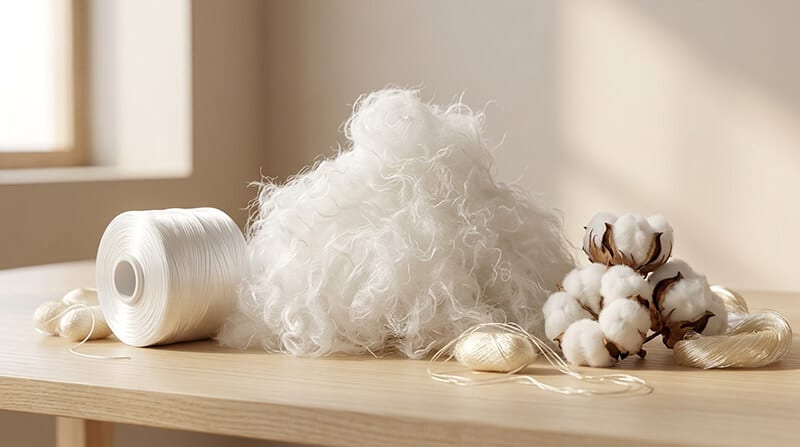
While pure PLA is outstanding for close-to-skin wear, its true potential in the apparel industry is unlocked when blended with traditional natural or regenerated cellulose fibers (such as cotton, linen, silk, wool, viscose, or Lyocell). PLA acts as a performance enhancer:
- PLA + Cotton: Pure cotton is soft but dries slowly and wrinkles easily. Blending PLA introduces a capillary effect, dramatically improving quick-drying capabilities and dimensional stability, making the fabric highly wrinkle-resistant while adding natural antibacterial properties.
- PLA + Linen: Linen offers a breathable, “cool” summer vibe but is famously coarse and stiff. PLA softens the fabric, balancing the coarse texture to create a much more skin-friendly, drape-heavy material without losing breathability.
- PLA + Silk: Pure silk is luxurious but extremely expensive and delicate. Blending PLA into silk increases the fabric’s stiffness and structural durability, significantly reducing production costs while maintaining a premium feel.
- PLA + Wool: Wool provides excellent warmth but is prone to shrinking and losing its shape. Adding PLA fiber helps maintain the warmth while introducing anti-shrink properties and anti-mite functionality, making winter sweaters and coats much easier to care for.
4. Innovation Spotlight: PLA Bi-component Staples
A signature, industry-leading product from eSUN is the PLA Bi-component Staple, produced with mature technology and stable quality. It is a specialized, 100% PLA fiber engineered with a sheath-core composite structure.
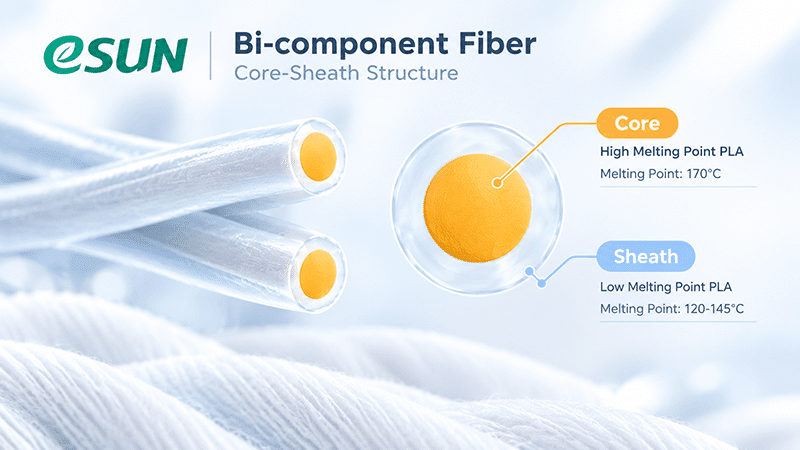
- The Sheath (Outer Layer): Composed of low-melting-point PLA (120°C – 145°C). It offers good softness and melts easily during heat treatment.
- The Core (Inner Layer): Composed of high-melting-point PLA (170°C). It maintains high structural strength and retains its fibrous form under heat.
How it works: After heat treatment, part of the sheath layer melts and acts as a bonding agent, while the remaining part retains its fibrous structure. The fibers interconnect with each other, forming a nonwoven fabric without the need for adhesives. Additionally, the fiber exhibits low thermal shrinkage characteristics.
Broad Processing Adaptability: This bi-component staple can be processed using most existing nonwoven methods, including thermal bonding, air through bonding, needle punching, wet-laid, air-laid, and spunlace.
It is particularly ideal for the air through penetration process to produce:
- Sanitary materials (diapers, sanitary pads)
- Thermal insulation fillings (quilts, clothing)
- Filtration materials
- Adhesive-free cotton & natural composite board bonding materials.
5. Major Applications of PLA Fiber
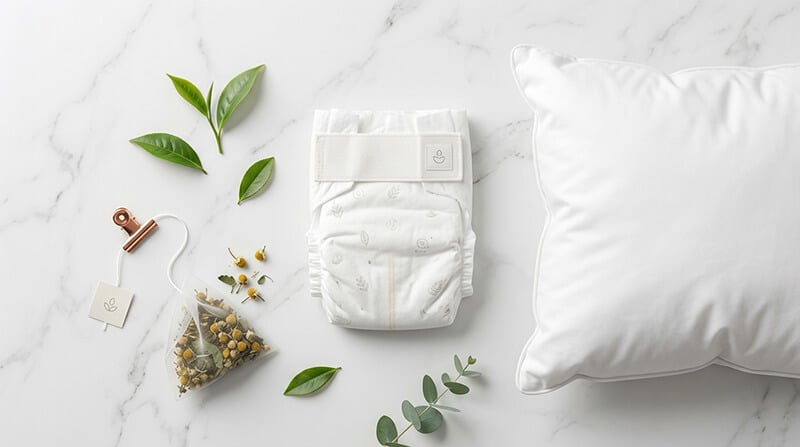
- Disposable Hygiene Products: The nonwoven hygiene market is rapidly “PLA-izing.” PLA fibers provide a dry, antibacterial, and hypoallergenic top sheet for diapers, facial cleansing towels, makeup remover wipes, and pet care pads.
- Home Textiles & Fillings: eSUN’s PLA Three-dimensional Crimped Staple replaces traditional polyester as a filling for quilts, pillows, and plush toys, offering high loft, resilience, and a mite-free sleep environment.
- Food & Beverage Packaging: In products like teabags and coffee filters, PLA fiber enables clean ultrasonic and thermal bonding. It ensures a safe brew with zero microplastic release and clean, neat bonding edges.
6. Partner with eSUN: Your Trusted PLA Fiber Supplier
As global regulations mandate the reduction of single-use plastics, transitioning to PLA fibers is both an environmental responsibility and a competitive business advantage.
eSUN is a global pioneer dedicated to differentiated and functional PLA fibers. With mature production technology and stable quality, we offer a full category of PLA fibers, including regular staples, ultra-short fibers, filaments, yarns, and our leading Bi-component staples.
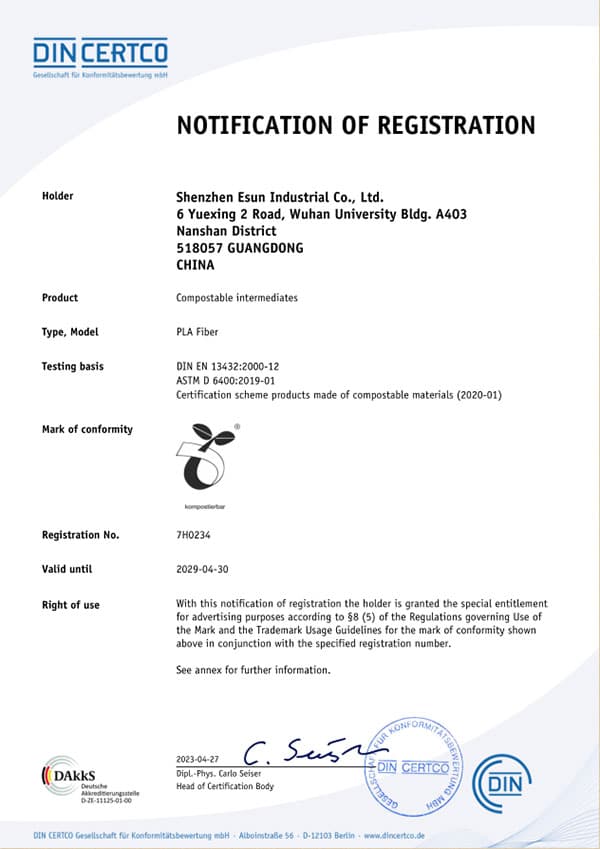
Our products hold multiple rigorous domestic and international certifications, including DIN CERTCO (Industrial Compostable), BPI, OEKO-TEX, and food safety compliance.
Looking to upgrade your production line with sustainable, high-performance materials? [Contact eSUN Today] to request samples, detailed technical data sheets, and customized nonwoven solutions.
